
Fourteen years after his final World Cup as a player, Diego Forlán is back at the heart of Uruguay’s national team.
Diego Forlán’s Biggest Challenges With Uruguay
After a disappointing group-stage exit at the 2026 World Cup, Diego Forlán takes charge of Uruguay with a unique dual role: rebuilding the senior team while also leading the U20s and strengthening the pathway for the country’s next generation.
This time, his responsibility is very different.
The Uruguayan Football Association appointed Forlán as head coach of both the senior and U20 national teams in August, following Uruguay’s disappointing performance at the 2026 World Cup. He succeeds Marcelo Bielsa, whose cycle ended after the tournament.
Forlán inherits a team that needs to recover quickly. Uruguay failed to win any of their three World Cup matches, drawing against Saudi Arabia and Cabo Verde before losing 1-0 to Spain. They finished third in Group H with two points and were eliminated before the knockout stage.
Recovering Uruguay’s Identity
Forlán’s appointment has a clear symbolic component.
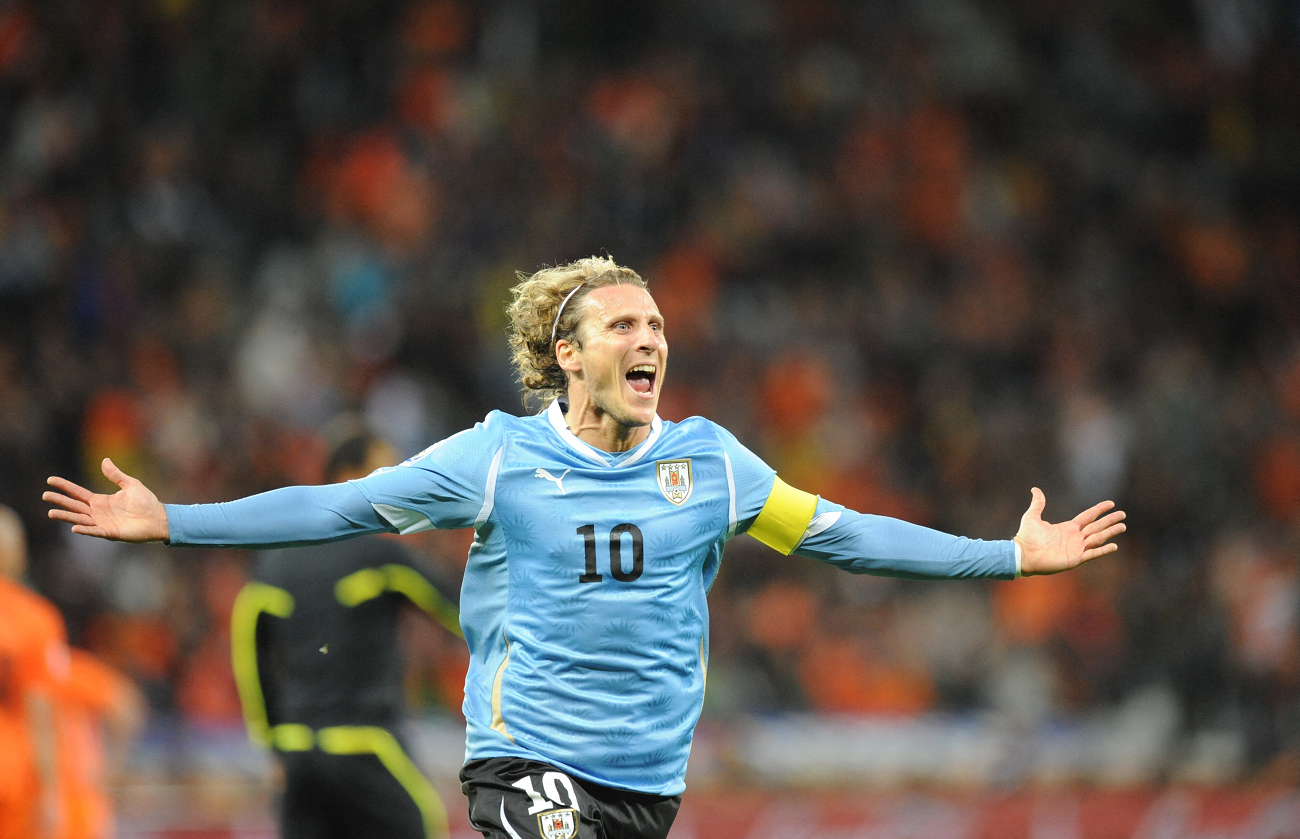
He scored 36 goals in 112 appearances for Uruguay, won the Golden Ball as the best player at the 2010 World Cup and helped the Celeste win the 2011 Copa América. He was also one of the leading figures of the national-team culture established under Óscar Tabárez.
Now he must translate that experience into coaching.
His first challenge is not simply tactical. Uruguay need to rediscover confidence and a clear identity after a World Cup in which a talented squad failed to translate its potential into results.
The objective will not necessarily be to recreate the Tabárez era, but to recover some of the continuity between generations and sense of belonging that characterized it.
Connecting the U20s With the Senior Team
Forlán’s dual role could become one of the most interesting elements of the project.

He will initially work directly with the U20 team, whose major objective is qualifying for the 2027 FIFA U20 World Cup in Azerbaijan and Uzbekistan. At the same time, he will oversee the senior national team.
That creates an opportunity to establish a direct pathway between youth football and the Celeste.
For a country with a population of around 3.5 million, identifying and developing talent has always been fundamental. Forlán will have the unusual advantage of personally working with players who could eventually become part of his senior squad.
The First Tests
His senior-team debut will arrive during the September-October international window.
Uruguay have confirmed friendlies against Japan on September 24 in Miyagi and South Korea on September 28 in Seoul. A third match against India has also been agreed for October 6, while the AUF is working to complete the Asian tour with another opponent.
These matches provide an ideal environment to experiment after the World Cup without immediate qualifying pressure.
There is another important factor: Forlán’s initial future is not completely open-ended. FIFA reports that he will lead the senior team at least until March 2027, when AUF presidential elections are scheduled.
That makes his first months particularly important.
The long-term destination is the 2030 World Cup, a tournament of enormous significance for Uruguay as the country prepares to host one of the centenary celebration matches. But before thinking that far ahead, Forlán must demonstrate that he can transform his legendary status as a player into authority and results as a coach.
His greatest challenge is clear: reconnect Uruguay’s past with its future without allowing nostalgia to define the project.