




- Home >
- Soccer >
- FIFA World Cup >
- Why Did Half the Planet Trust an Octopus? The Story of the Animals That Became World Cup Oracles and Captivated Millions of Fans
Why Did Half the Planet Trust an Octopus? The Story of the Animals That Became World Cup Oracles and Captivated Millions of Fans
From the famous Paul the Octopus to cats, turtles, otters, and camels, several animals became celebrities thanks to their supposed football predictions. This is how one of the most curious World Cup traditions was born.
How Did the Animal Oracle Craze Begin?
For years, football embraced one of its strangest and most fascinating traditions: animals supposedly capable of “predicting” match results. Although it may seem like an internet curiosity today, millions of fans followed their predictions with genuine anticipation.
Zoos, aquariums, and conservation centers found an original way to connect with the public during major international tournaments. What started as a simple recreational activity eventually became a global phenomenon.
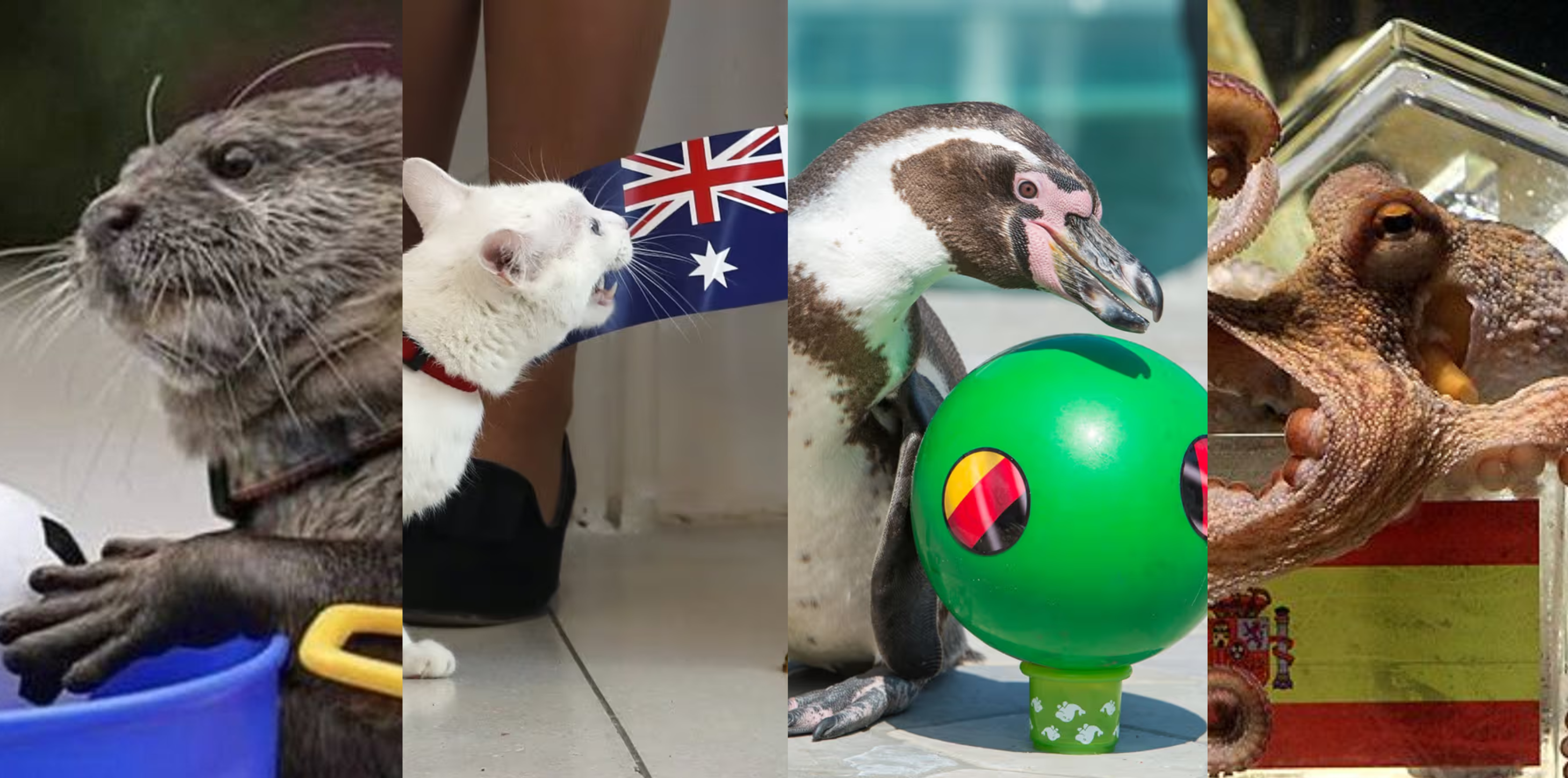
The biggest star of this trend was Paul, the German octopus who achieved worldwide fame during the 2010 FIFA World Cup in South Africa.
Paul the Octopus Amazed the Entire World
Paul became an international celebrity after correctly predicting the outcomes of Germany’s matches during the 2010 World Cup. His method was simple: choosing between two boxes decorated with the flags of the competing teams.
The moment that turned him into a legend came when he correctly predicted that Spain would defeat Germany in the semifinals and later become world champions, something very few experts were willing to predict at the time.
His fame grew so much that he appeared in media outlets around the world and became one of the most memorable symbols of that World Cup.

Otters, Turtles, Cats, and Camels Followed in His Footsteps
Paul’s success opened the door for other animals to take on the role of sporting “oracles.”
At Qatar 2022, for example, the otter Taiyo attracted attention after anticipating Japan’s surprising victory over Germany. Other figures also emerged, such as Shaheen the camel, who made his predictions by walking toward one of the flags placed in front of him.
Over the years, turtles, penguins, seals, and even cats joined the trend. One of the most curious cases was Achilles, a white cat who gained notoriety during Russia 2018. His promotional campaign highlighted that he was deaf, a characteristic that supposedly prevented him from being influenced by the noise of fans.
Every tournament seemed to find a new animal ready to take Paul’s place.
Could They Really Predict Matches?
There is no scientific evidence suggesting that these animals possess any special ability to predict sporting outcomes.
The simplest explanation is statistics. If hundreds of animals make completely random choices, some will inevitably put together a streak of correct predictions that captures public attention.
Behind most of these cases was a combination of entertainment, curiosity, and a highly effective communication strategy.
The Human Need to Find Certainty in an Unpredictable Sport
Football is one of the most unpredictable sports in the world. Even the best analysts, statistical models, and experts are constantly proven wrong. In that context, the idea that an octopus, a turtle, or an otter might know the future is as absurd as it is entertaining.
And that is precisely where the appeal lies.
Animal oracles became a fun way to experience the excitement before matches, reminding us that no matter how many statistics and predictions exist, the magic of football remains the fact that nobody truly knows what will happen once the ball starts rolling.


