
The Most Iconic Jerseys in FIFA World Cup History
A jersey is more than just a piece of fabric. It represents identity, history, and national pride. It carries an entire country on the shoulders of its players and, in many cases, becomes an enduring symbol because of the moments it witnessed on the pitch.
Some became legendary because of their design, others because of the trophies they helped win, and a few because of both. These are some of the most iconic jerseys in FIFA World Cup history.
Mexico 1998
In the mid-1990s, the Mexican Football Federation made an unusual decision: instead of turning to one of the major international brands, it chose a domestic company. That is how Aba Sport became responsible for dressing Mexico for France 1998.
Designer Ignacio Villarreal created a concept that completely broke with tradition. For the first time, a Mexican national team jersey incorporated elements of the country's pre-Hispanic heritage. The Aztec Sun Stone served as the primary inspiration, while the face of Tonatiuh, the Aztec sun god, dominated the design.
The goal was clear: to showcase Mexico's history on football's biggest stage.
Wearing that jersey, Luis Hernández scored four goals at France 1998 and emerged as one of the tournament's standout performers. Alongside Jorge Campos, Cuauhtémoc Blanco, and the rest of the squad, he helped cement the shirt's place in Mexican football history.
More than a jersey, it became a cultural symbol.
Brazil 1970
Few jerseys are as instantly recognizable as Brazil's famous yellow shirt.
However, the version worn by Brazil at Mexico 1970 achieved legendary status because it was worn by one of the greatest teams ever assembled.
The design was simple: bright yellow, green trim, and the federation crest on the chest. It needed nothing more.
With Pelé, Tostão, Rivelino, Gérson, and Carlos Alberto, Brazil played a brand of football many consider the sport's highest expression. Their 4-1 victory over Italy in the final at the Estadio Azteca transformed that jersey into a football monument.
Since then, Brazil's yellow shirt has become more than a national uniform—it has become a global symbol of attacking, entertaining football.
Argentina 1986
The 1986 FIFA World Cup belongs to Diego Armando Maradona.
For that reason alone, Argentina's jersey from that tournament holds a special place in football history.
Manufactured by Le Coq Sportif, it featured an interesting variation from previous designs. The traditional sky-blue and white stripes were rearranged with a central white stripe, an uncommon look at the time.
Yet its true significance comes from what happened on the field.
Wearing Argentina's colors, Maradona produced the "Hand of God," the "Goal of the Century," and one of the most dominant individual performances ever seen at a World Cup. The away jersey has a wondeful story worth reading
It is impossible to look at that jersey without picturing the No. 10 lifting the trophy at the Estadio Azteca.
Germany 1990
Until 1990, West Germany had largely favored conservative jersey designs.
Then Adidas broke tradition with a revolutionary concept. Across the chest ran a geometric pattern featuring the colors of the German flag: black, red, and gold.
It was modern, elegant, and unlike anything the team had worn before.
The jersey also arrived at a pivotal historical moment. Germany was only months away from reunification following the fall of the Berlin Wall.
Led by Lothar Matthäus on the field and coached by Franz Beckenbauer, Germany won the 1990 FIFA World Cup in Italy. The jersey ultimately came to represent far more than a championship—it symbolized the birth of a new Germany.
France 1998
For decades, France had been respected on the international stage but had never won a World Cup.
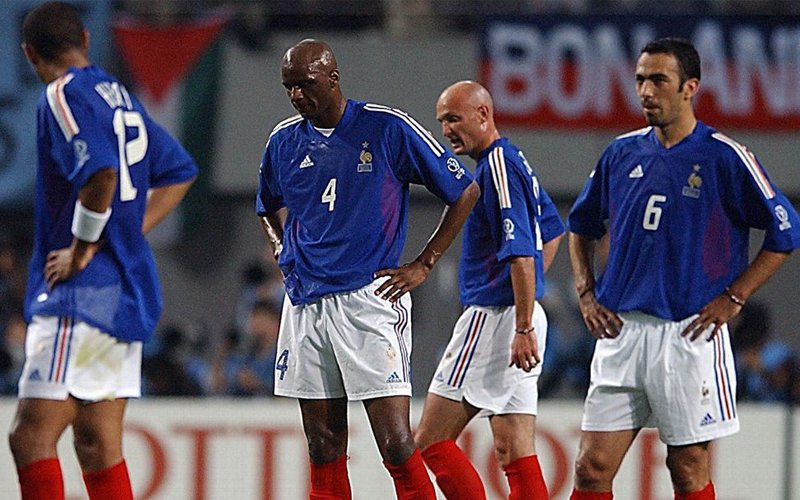
As hosts of the 1998 tournament, Adidas introduced a design inspired by the kits worn during UEFA Euro 1984, when Michel Platini led the French to European glory.
The dark blue jersey, accented by a bold red stripe and white details, elegantly reintroduced the nation's traditional colors.
This time, however, the hero was not Platini.
It was Zinedine Zidane.
With two goals in the final against Brazil, "Zizou" guided France to its first World Cup title and turned that jersey into one of the most significant shirts of the modern era.
Croatia 1998
When Croatia made its World Cup debut in 1998, it had only recently emerged as an independent nation.
It needed a national identity.
And it found one immediately.
The iconic red-and-white checkered jersey was inspired by the Croatian coat of arms and looked unlike anything else seen on the World Cup stage.
Led by Davor Šuker, Zvonimir Boban, and Robert Prosinečki, Croatia shocked the world by finishing third.
Football fans everywhere fell in love with the shirt.
Since then, Croatia's checkered design has become one of the most recognizable and admired identities in international football.
England 1966
Some designs stand the test of time because of their elegance.
England's 1966 jersey is one of them.
Umbro created an all-white home kit and a red away version. Without unnecessary embellishments, it embodied the understated tradition often associated with English football.
It was the jersey worn by England when the nation won its only World Cup title.
The image of Bobby Moore lifting the Jules Rimet Trophy at Wembley Stadium became one of the most iconic photographs in sports history.
For many, that jersey remains the definitive image of classic English football.
Netherlands 1974
When discussing cultural impact, few jerseys changed perceptions of football as dramatically as the orange shirt worn by the Netherlands at the 1974 FIFA World Cup.
It did not win the tournament, but it revolutionized the sport.
Led by Johan Cruyff and guided by coach Rinus Michels, the Dutch showcased the famous "Total Football" philosophy, turning their orange jersey into the uniform of a tactical revolution that transformed the game forever.
As a historical footnote, Adidas sponsored the Netherlands, while Cruyff had a personal contract with Puma. To avoid commercial conflicts, Cruyff's jerseys featured only two stripes instead of Adidas' signature three.
Sometimes, lifting the trophy is not necessary to achieve immortality.
Some jerseys win championships.
Others change the history of football.