
How Johan Cruyff Change Football?
Ten years after the passing of Johan Cruyff, the Dutchman still has an enormous influence on modern football. It can even be said, without exaggeration, that he completely changed the sport and that much of the football we enjoy today exists thanks to his understanding of the game.
Cruyff goes far beyond numbers. The mere fact that he transformed the way football is interpreted makes him, arguably, the brightest mind and the most important figure in modern football.
As a player, he was a revolutionary in every sense. Under the guidance of Rinus Michels, he helped change the game on the pitch. The Dutch coach was the one who instilled in him the idea of “Total Football,” the style that turned Ajax into the dominant force in Europe during the 1970s. They won three consecutive European Cups, and Cruyff was the soul of that team.
That led him to win three Ballon d'Or awards—the first to do so—but it was not just about talent or statistics, it was about the way he played. He had no fixed position because he understood space like no one else. He knew where to position himself to cause the most damage and, on the pitch, he could reshape the team’s structure with his intelligence. His reading of the game was so extraordinary that even Michels realized nothing could be restricted with him. At one point, he summed it up perfectly: “You have to let Johan be.”
“Football is a game of mistakes; whoever makes fewer, wins.”
That freedom was revolutionary for its time. Back then, systems were rigid and roles were clearly defined. Cruyff broke all of that. He understood before anyone else that constant movement, positional interchange, high pressing, and attacking aggression could completely disrupt any opponent.
The world was stunned when the Netherlands national team reached the final of the 1974 World Cup. They did not lift the trophy, but they achieved something just as powerful: the admiration of the entire planet. That “Clockwork Orange” side not only dazzled with results but with the way it played. Its style left such a deep mark that it forever changed how many national teams and clubs began to understand football.
His personality was also ahead of its time. Cruyff had a contract with Puma, and by 1974 he had already signed a sponsorship deal with the German brand. Heading into that year’s World Cup, that agreement prevented him from promoting other sports brands.
So when the time came to play the tournament, he flatly refused to wear the traditional jersey of Adidas with the three black stripes on the sleeves of his number 14 shirt. The Dutch Football Federation had virtually no choice but to respect the stance of its biggest star, who even threatened not to play in the World Cup.
In the end, Dutch officials convinced Adidas to produce a special jersey exclusively for Cruyff, different from the rest of the team. Instead of the classic three stripes, his shirt had only two on the sleeves. An unthinkable gesture at this time, and yet another example that Johan Cruyff not only transformed the game on the pitch, but also asserted his influence off it.
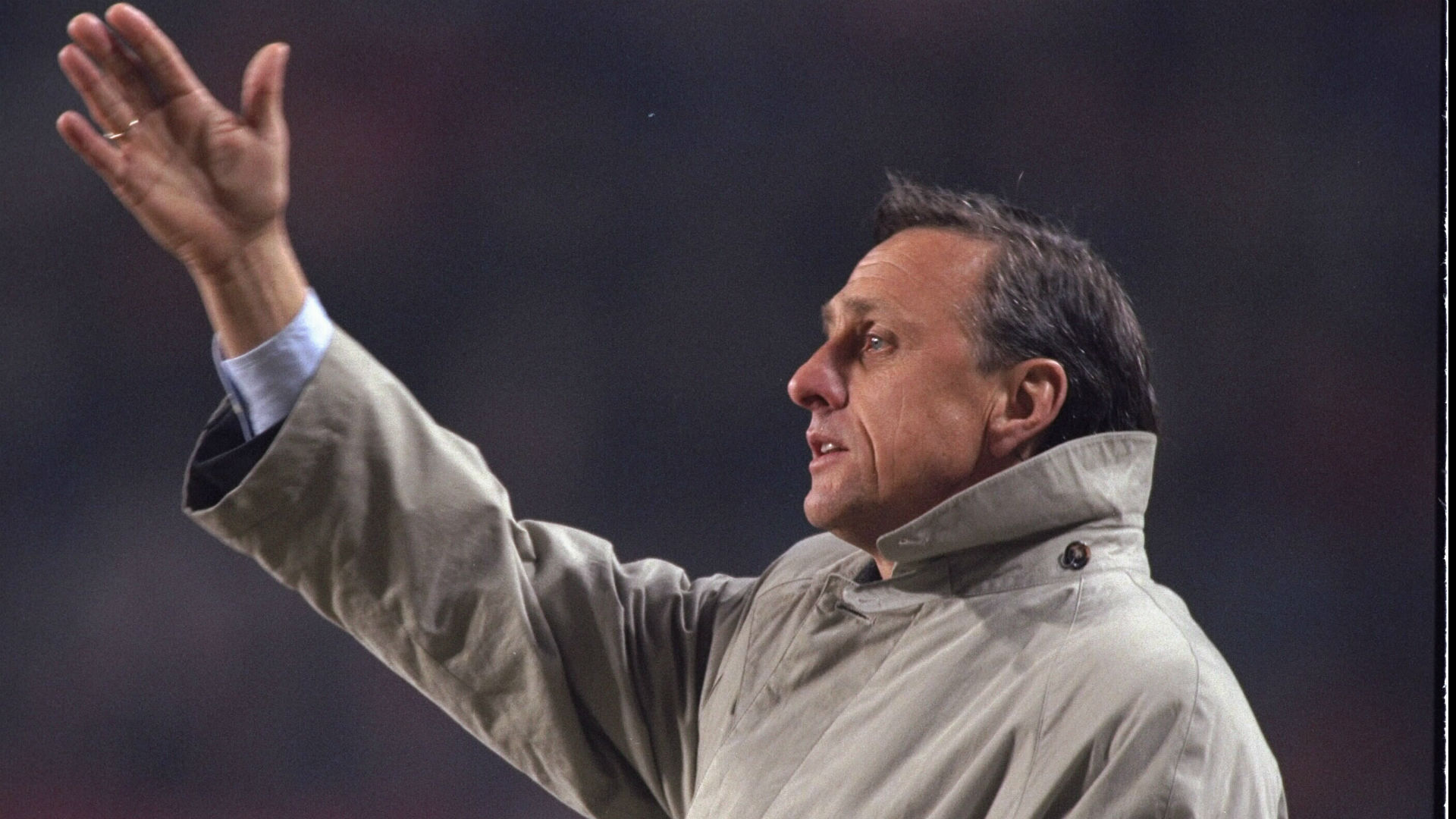
“If you have the ball, the opponent cannot score.”
As a coach, his influence was just as decisive. He revolutionized FC Barcelona with the creation of the famous Dream Team, the side that won the club’s first European Cup in 1992. His vision was often questioned, but he was almost always right. One of the best examples was his bet on a young Josep Guardiola, a player who, before his arrival, did not even seem destined to become a key figure. Cruyff saw in him something few had detected: the ability to think the game on another level.
For Cruyff, the most important thing was decision-making and how a player adapts to each moment of the match. His vision of football was summed up in a brilliant quote: “Technique is not being able to juggle a ball 1,000 times. Anyone can do that with practice. Then go and work in the circus. Technique is passing the ball in one touch, with the right speed, at the right time, to the right foot of your teammate.” Pure genius.
His way of seeing football also seemed simple, though it actually hid enormous complexity. That is why his teams prioritized possession, quick circulation, and vertical passing. There lies one of the clearest roots of the style the world later came to know as tiki-taka.
Josep Guardiola took that philosophy to its peak with Barcelona’s treble-winning side, a team in which “the goalkeeper was the first attacker” and where Lionel Messi often embodied that role of creative freedom that defined Cruyff: leaving his zone, attracting defenders, breaking structures, and controlling the attack through intelligence. In many ways, one of the greatest teams in history was first born in the imagination of Johan Cruyff.
Ten years after his passing, Cruyff lives on in every well-played match, in every team that embraces possession, in every high press, and in every player who understands that space is also part of the game. More than a legend, he was the architect of a new way of seeing this sport.
Johan Cruyff did not just change football. He practically invented modern football.
The Eternal 14
“Playing football is very simple, but playing simple football is the hardest thing there is.”